In the coatings industry, achieving a smooth, uniform, and defect-free surface finish is one of the most important goals for manufacturers. However, during coating application and curing, surface problems such as orange peel, shrinkage, craters, pinholes, poor gloss, and uneven flow can easily occur due to differences in surface tension, resin compatibility, solvent evaporation, and substrate conditions.
A leveling agent is a functional coating additive designed to improve the flow and leveling performance of coatings. It helps the coating film spread evenly, reduces surface defects, enhances gloss, and improves the overall appearance of the final product.
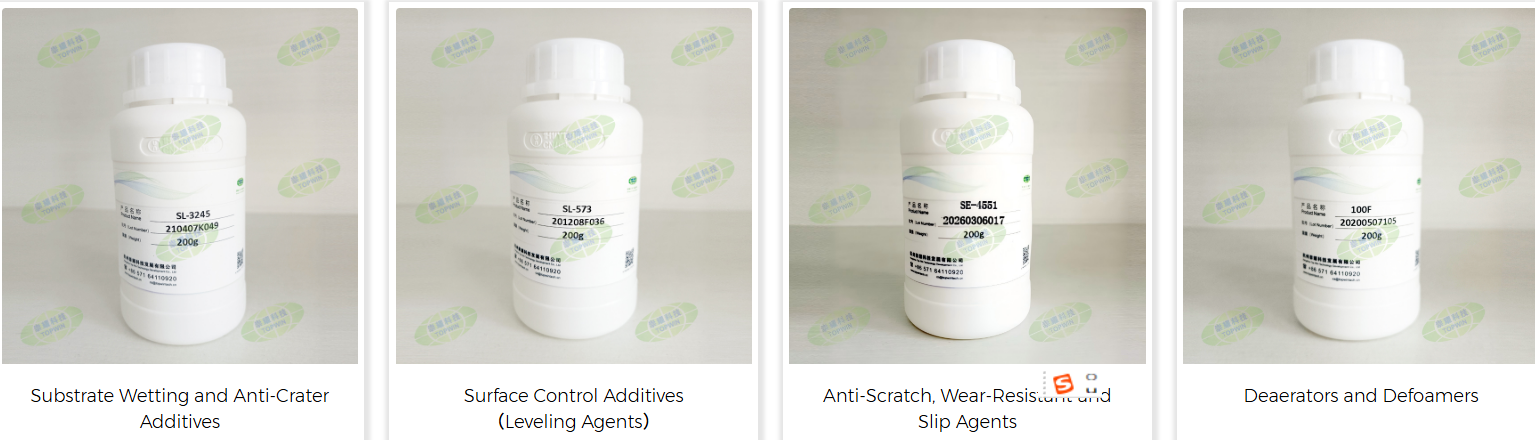
Leveling agents are widely used in:
Industrial coatings
Automotive paints
Wood coatings
UV coatings
Printing inks
Powder coatings
Plastic coatings
Choosing the correct leveling agent is essential because different coating systems require different additive technologies.
A leveling agent is a type of surface-active additive that modifies the surface properties of a coating system. Its main function is to control surface tension differences and improve the ability of liquid coatings to flow and spread before curing.
During coating application, uneven surface tension can cause coating defects. A suitable leveling agent balances these forces, allowing the coating film to form a smoother and more consistent surface.
The main functions of leveling agents include:
Improving coating flow and leveling
Reducing surface defects
Enhancing gloss and smoothness
Improving substrate wetting
Increasing scratch resistance
Preventing shrinkage and cratering
The performance of a leveling agent is mainly related to surface tension control.
When a coating is applied, differences in surface tension may create uneven flow. For example, areas with higher surface tension may pull the coating away from surrounding areas, causing defects such as fisheyes or craters.
A leveling agent migrates to the coating surface and adjusts the surface tension balance. This improves:
Coating spreading
Pigment orientation
Surface smoothness
Film uniformity
Silicone-based leveling agents, especially silicone-polyether copolymers, are commonly used because they provide strong surface tension reduction, excellent slip properties, and good surface smoothness.
Different coating systems require different types of leveling additives. The most common categories include silicone leveling agents, acrylic leveling agents, and polyurethane leveling agents.
Silicone leveling agents are among the most widely used additives due to their excellent surface performance.
They are usually based on modified silicone polymers, such as polyether-modified siloxane copolymers.
Excellent flow and leveling performance
Strong surface tension reduction
Improved gloss
Better surface slip
Enhanced scratch resistance
Improved substrate wetting
Silicone leveling agents are suitable for:
Solvent-based coatings
Water-based coatings
UV-curable coatings
Printing inks
However, excessive silicone migration may sometimes affect intercoat adhesion in multilayer coating systems. Therefore, compatibility testing is important before large-scale production.
Acrylic leveling agents are commonly used when good compatibility and recoating performance are required.
Compared with silicone additives, acrylic leveling agents generally have less influence on surface adhesion between coating layers.
Benefits include:
Good compatibility with resin systems
Improved film smoothness
Reduced surface defects
Excellent recoating performance
They are often used in:
Industrial coatings
Automotive refinishing coatings
Protective coatings
For applications requiring multiple coating layers, acrylic leveling agents can provide a good balance between leveling performance and adhesion. (建德市思利贝进出口公司)
Polyurethane-based leveling agents provide excellent compatibility and surface control.
They are often selected for coatings requiring:
High durability
Good appearance
Strong mechanical performance
Typical applications include high-performance industrial coatings and specialty finishes.
Selecting the correct leveling agent depends on several important factors.
Different coating systems require different additives.
Water-based coatings usually have higher surface tension, so strong wetting and leveling performance is required.
Silicone-based leveling agents are commonly used to improve:
Surface wetting
Flow performance
Film smoothness
Solvent-based systems require good compatibility between the additive and resin.
Important considerations include:
Resin type
Solvent polarity
Drying speed
UV coatings require additives that can improve surface properties without interfering with curing.
Suitable leveling agents should provide:
Good leveling
Low surface defects
Minimal impact on curing performance
Compatibility is one of the most important factors when selecting a leveling agent.
Poor compatibility may cause:
Haze
Surface defects
Gloss reduction
Layer separation
The leveling agent should be tested with:
Resin
Pigments
Solvents
Other additives
A small laboratory test before production can prevent costly quality problems.
Different applications have different priorities.
For example:
Require:
High gloss
Smooth appearance
Scratch resistance
Require:
Durability
Adhesion
Surface protection
Require:
Good flow
Fast drying
Uniform appearance
Selecting additives based on the final application ensures better coating performance.
The dosage of leveling agent has a significant influence on coating performance.
Too little additive may not provide sufficient leveling effect.
Too much additive may cause:
Adhesion problems
Surface contamination
Reduced recoatability
The recommended dosage depends on the product type and formulation. For many silicone leveling agents, typical addition levels are often within a low percentage range, but manufacturers should optimize dosage through testing. (建德市思利贝进出口公司)
Orange peel refers to an uneven surface texture similar to citrus skin.
Causes include:
Poor flow
High viscosity
Fast solvent evaporation
Leveling agents improve coating flow and help create a smoother surface.
These defects are often caused by contamination or uneven surface tension.
Leveling agents improve substrate wetting and reduce surface tension differences, helping prevent these problems. (建德市思利贝进出口公司)
A rough coating surface scatters light and reduces gloss.
Proper leveling improves surface smoothness and enhances visual appearance.
Poor wetting can lead to uneven coverage and adhesion problems.
Leveling agents improve contact between the coating and substrate.
Used to achieve:
High gloss finishes
Smooth surfaces
Better appearance quality
Applications include:
Metal coatings
Machinery coatings
Protective coatings
Leveling agents improve durability and surface appearance.
They provide:
Better surface smoothness
Improved touch feeling
Enhanced decorative effect
Leveling agents help improve:
Ink spreading
Print quality
Surface finish
To achieve the best results:
Many leveling agents are added during the final formulation stage to optimize surface performance.
Small-scale compatibility testing is recommended because coating formulations vary significantly.
More additive does not always mean better performance. Excessive dosage may create new defects.
A good leveling agent should balance:
Flow
Slip
Adhesion
Recoatability
Surface appearance
Leveling agents are essential additives for producing high-quality coatings with smooth surfaces, excellent gloss, and reduced defects. By controlling surface tension and improving coating flow, they help manufacturers achieve better appearance and performance across various applications.
When selecting a leveling agent, manufacturers should consider coating type, resin compatibility, required surface properties, and application conditions. Silicone-based, acrylic, and polyurethane leveling agents each provide unique advantages for different coating systems.
With the increasing demand for high-performance coatings, advanced leveling agent technologies will continue to play an important role in improving coating quality, efficiency, and durability.
Topwin is one of the leading professional manufacturers and solution providers with more than 20 years of experience, and has domestic top-level engineers in the silicone surfactant industry. Specializing in research and development, production, sales, and marketing of silicone-based special functional performance materials, Topwin also serves as a professional provider of technical services. Now our products are widely used in Polyurethane Foam, Corp Protection, Coatings and Inks, Leather & Textile, Release Coating for Paper & Film,Home & Personal Care, and others.