The organic solvents in traditional solvent‑based coatings and diluents used during applications , are classified as volatile organic compounds (VOCs). They are important precursors to the formation of ozone (O₃) and fine particulate matter (PM₂.₅) pollution. In contrast, the main solvent in waterborne coatings is water. By reducing VOC emissions at the source, waterborne coatings not only lower costs for enterprises but are also more environmentally friendly and safer. As a result, they have enjoyed broad development prospects in recent years.
Because the surface tension of water is as high as 72 mN/m, and the surface tension of aqueous emulsion resins is also high, waterborne coatings are difficult to wet and spread on substrates such as steel to form a uniform and continuous film. During application, poor wetting can lead to surface defects such as edge shrinkage, cratering, and coverage, which will reduce protective performance and poor decorative appearance. The wetting and spreading phenomenon in coatings is the process by which air on the substrate surface is displaced by the coating. In essence, this process replaces the gas–solid interface with a solid–liquid interface while simultaneously expanding the gas–liquid interface. The wetting behaviour of a waterborne coating on a substrate is influenced by three factors: the surface tension of the substrate (γsg)), the surface tension of the coating (γlg), and the surface tension between the coating and the substrate (γsl). For a waterborne coating to exhibit excellent wetting and spreading on the substrate, the condition γsg —γlg—γsl>0 must be satisfied. Adding substrate wetting agents to the waterborne coating can effectively reduce γlg and γsl, thereby enabling spreading on the substrate to form a uniform film and avoiding coating defects.
Commonly used substrate wetting agents in coatings include polyether silicones, gemini silicones, fluorine-based agents, and gemini polyether alkynediols. We selects four kinds of agents and conducts a comparative study against gemini silicone to evaluate their influence on the performance of water-based coatings applications.
1.The static surface tension of 0.1% aqueous solutions with different substrate wetting agents
|
substrate wetting agent |
Silicone polyether A |
Silicone polyether B |
Gemini polyether alkynediol |
Fluorochemical |
Gemini silicone SL-5100 |
|
Surface tension(mN/m) |
20.5 |
25.0 |
33.4 |
16.5 |
22.5 |
The table shows that fluorosurfactant is the most effective in lowering the static surface tension of water, followed by silicone-based agents. Among the Polyether-modified silicone, the short-chain polyether silicone A gives the greatest reduction in static surface tension, followed by the gemini silicone SL-5100, and the medium-chain polyether silicone B shows a relatively weaker effect.
2.Foam instability of 0.1% a queous solutions of various substrate wetting agents
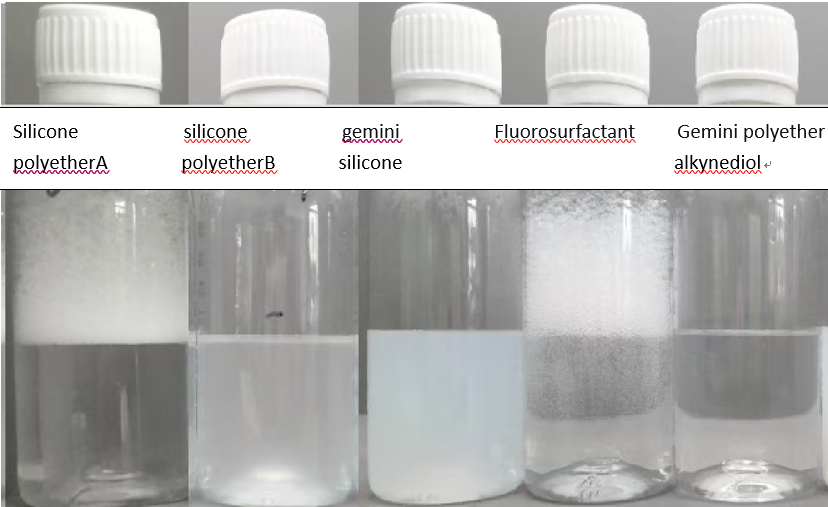
As can be seen from the test, polyether silicone A and fluorosurfactant D exhibit pronounced foam stabilization in aqueous solution, whereas polyether silicone B, gemini polyether alkynediol , and gemini silicone SL-5100 have excellent low‑foaming properties.
3.Foam instability of different kinds of substrate wetting agents for Water-based coating
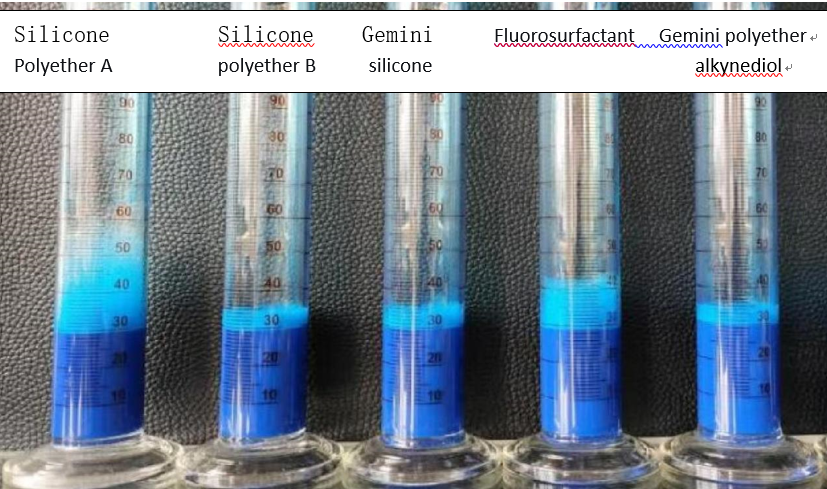
From this test, polyether silicone B, gemini polyether alkynediol , and gemini silicone SL-5100 show superior low‑foaming performance over polyether silicone A and fluorosurfactant in waterborne coatings, but the difference is less significant than in aqueous solutions. This is because in aqueous solutions, the only one substrate wetting agent is the sole factor affecting foam generation and stabilization, whereas waterborne coatings also include resin emulsions, polyurethane thickeners, and dispersants, all of which can affect foaming.
4.Crater resistance of different types of substrate wetting agents in waterborne coatings
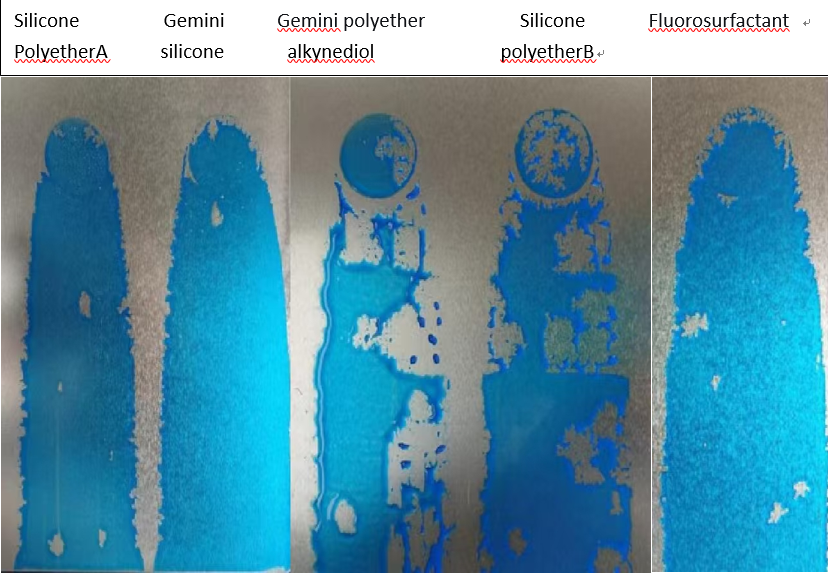
Polyether silicone A, fluorosurfactant , and gemini silicone SL-5100 all provide excellent crater resistance in waterborne coatings, whereas polyether silicone B and gemini polyether alkynediol have comparatively poorer anti‑cratering effects.
5.The edge shrinkage resistance performance of various types of substrate wetting agents in waterborne coatings
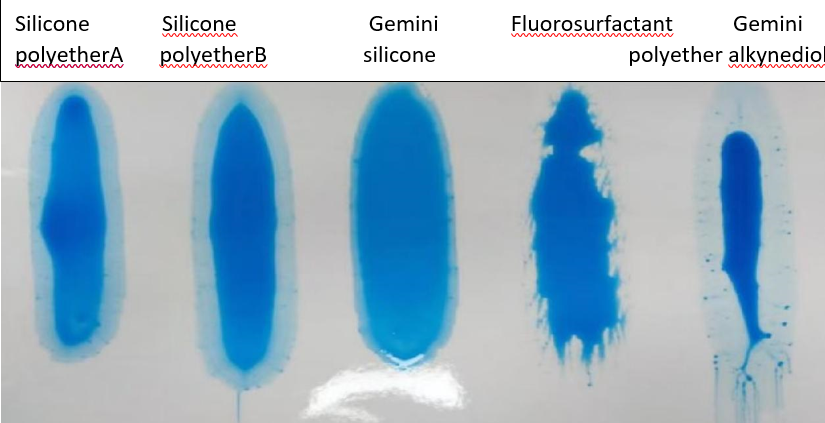
As shown in the figure, gemini silicone SL-5100 offers the best edge shrinkage resistance, followed by polyether silicone A, fluorosurfactant , and polyether silicone B, whereas gemini polyether alkynediol gives the worst performance. The edge shrinkage resistance reflects the combined performance of the wetting/spreading and leveling performance. Silicone polyether A and fluorosurfactant show good wetting/spreading, hence their edge shrinkage resistance is moderate. Silicone polyether B has good levelling performance, but moderate wetting/spreading performance, so its edge shrinkage resistance is likewise moderate. Gemini polyether alkynediol has poor wetting and edge shrinkage resistance is worst. Gemini silicone SL-5100 provides excellent wetting/spreading and leveling performance, which gives it superior edge shrinkage resistance.
Though Gemini silicone SL-5100 does not exhibit a significant advantage in reducing the surface tension of aqueous solutions, it performs excellent low foaming, anti‑cratering, wetting/spreading, and leveling performance in waterborne coatings.